Other Briefings
Do Property Owners Pay Tax in the UAE? Key Rules for Real Estate Investors
The UAE is no longer a tax-free environment for all real estate investors. This article explains how corporate tax, VAT, free zone rules, transfer fees, and ownership structures affect property owners and investors.
The UAE is still one of the most tax-efficient real estate markets in the world. But it is no longer accurate to assume that property ownership is automatically “tax-free.”

Over the past decade, the UAE has introduced a more mature tax framework. VAT has applied since 2018, and federal corporate tax applies to financial years starting on or after June 1, 2023. For real estate investors, this means tax exposure now depends on how the property is owned, what type of property it is, and whether the activity is passive investment or a business.
The key question is not simply whether property owners pay tax in the UAE. The better question is: who owns the property, how is it used, and through what structure?
Practical checklist for UAE property investors
Before buying, transferring, or restructuring UAE real estate, investors should ask:
- Who owns the property?
Individual, UAE company, free zone entity, foreign company, fund, or foundation. - What type of property is it?
Residential, commercial, mixed-use, hotel, serviced apartment, land, or industrial asset. - Is the income passive or business income?
Long-term rental income may be treated differently from short-term rental or active trading. - Is a license required?
Licensed activity can change the corporate tax position for individuals. - Where is the property located?
Mainland UAE and free zone property can have different tax outcomes. - Who is the tenant or buyer?
This is especially important for free zone structures. - Is VAT recoverable?
Exempt residential supplies can create hidden unrecovered VAT costs. - Will the transfer change the beneficial owner?
This may affect transfer fees. - Are related parties involved?
Transfer pricing and anti-avoidance rules may apply. - Does a foreign company create UAE tax nexus?
Offshore ownership may still trigger UAE tax obligations.
Corporate tax and UAE real estate
The UAE corporate tax regime applies a standard rate of nine percent on taxable income exceeding AED 375,000 (US$102,000). For real estate, this mainly affects companies and other legal entities. A company may be subject to corporate tax if it earns income from:
- Leasing property;
- Selling property;
- Developing real estate projects;
- Managing property assets;
- Providing real estate services; and
- Holding commercial or residential property as an investment.
This means that rental income, gains from selling property, development profits, and management fees can fall within the corporate tax base when earned by a company.
Corporate ownership can still make sense for investors, especially for larger portfolios, institutional investors, developers, or family offices. However, the tax position now needs to be considered from the start. A UAE company holding real estate may need to register for corporate tax, maintain proper accounts, calculate taxable income, and file an annual tax return.
Individuals: When real estate income may remain outside corporate tax
The position is more favorable for individuals.
In general, an individual who owns UAE real estate for personal use, long-term rental, or passive investment may fall outside the corporate tax regime. This applies where the activity is not conducted through a license and does not require a license from a competent authority.
This is important for foreign investors. A non-resident individual may own residential property in the UAE and earn rental income without automatically becoming subject to UAE corporate tax, provided the activity remains passive real estate investment.
Direct personal ownership may therefore be tax efficient in cases such as:
- Buying a residential apartment for personal use;
- Holding a villa for long-term capital appreciation;
- Renting out a residential property on a long-term basis; or
- Owning UAE property as a non-resident individual investor.
However, the line between passive investment and business activity can become blurred.
Tax risk may increase where an individual is:
- Frequently buying and selling properties;
- Renovating and flipping units for profit;
- Operating short-term rentals or holiday homes;
- Managing multiple properties in an organized way;
- Using agents, platforms, staff, or SPVs to run the activity; and
- Operating under a trade license.
Once the activity starts to look like a business, the tax treatment may change.
Free zone structures: Zero percent is not automatic
Free zones remain attractive for foreign investors, but the zero percent corporate tax rate is conditional. It applies only to qualifying income earned by a Qualifying Free Zone Person.
For real estate, the details matter.
A free zone company may benefit from zero percent corporate tax where it earns qualifying income from commercial real estate located in a free zone and leased to another Free Zone Person.
However, not all free zone real estate income qualifies. The standard nine percent corporate tax rate may apply where income is earned from:
- Residential real estate;
- Mainland property;
- Commercial property leased to a mainland tenant;
- Property located outside the free zone;
- Income that does not meet the qualifying income rules.
The main point is simple: the tax treatment follows the income, property type, location, and counterparty, not just the company’s free zone license.
A free zone license alone does not guarantee zero percent tax.
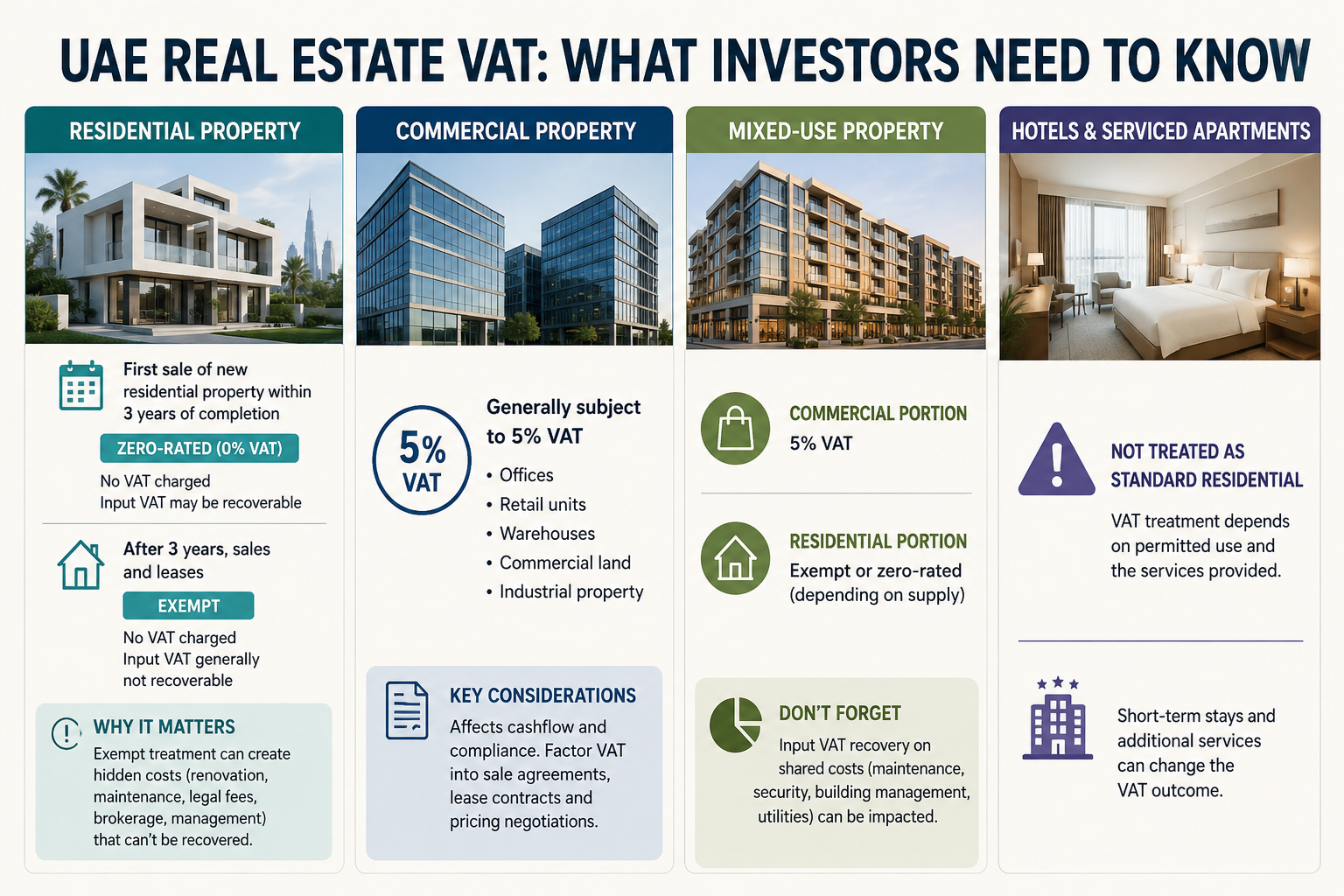
VAT treatment of UAE real estate
VAT is often the most overlooked cost in UAE property transactions. The UAE VAT rate is five percent, but the treatment depends on the property type.
Transfer fees and transaction costs
The UAE does not generally impose an annual property tax, but property transfers are subject to emirate-level fees. Dubai is the most important example. The Dubai Land Department commonly applies a transfer fee of four percent of the property value or purchase price.
For example:
- On a property worth AED 1 million, approximately US$272,000, the four percent transfer fee would be AED 40,000, approximately US$10,900.
- On a property worth AED 5 million, approximately US$1.36 million, the four percent transfer fee would be AED 200,000, approximately US$54,500.
Transfer fees are not the same as corporate tax or VAT, but they are a major transaction cost and should be priced into the investment from the start.
Transfer fee issues can become more complex when property is held through a company, foundation, or other vehicle. A change in ultimate beneficial ownership may trigger transfer fee consequences. In some cases, where an individual transfers property to a vehicle but remains the ultimate beneficial owner, a reduced fee of 0.125 percent may apply, subject to the relevant conditions.
Foreign companies holding UAE property
Foreign companies that own UAE real estate need careful tax review.
A non-resident company may create a UAE tax nexus if it earns income from immovable property located in the UAE. This means rental income or gains from UAE property may become taxable in the UAE, even if the company is incorporated abroad.
This is relevant for:
- Offshore companies;
- Foreign SPVs;
- Family holding companies;
- Cross-border property structures;
- International real estate funds.
Foreign corporate ownership can also create practical issues with banks, land departments, due diligence, beneficial ownership disclosure, and tax registration.
For some investors, direct personal ownership or a UAE-based structure may be simpler. For others, a foreign company may still be appropriate, but the tax and administrative consequences should be reviewed before acquisition.
REITs, funds, and foundations
Larger investors may consider structures such as:
- Real Estate Investment Trusts;
- Qualifying investment funds;
- DIFC or ADGM foundations;
- Family office structures;
- Holding companies.
These structures can support asset protection, succession planning, governance, and investor pooling. But they are not automatically tax-free.
For example, a foundation may be tax transparent only if the relevant conditions are met. A fund or REIT may benefit from tax treatment only where it satisfies the applicable exemption or qualifying investment fund rules.
The right structure depends on the investor’s profile. A single individual buying one apartment for long-term rental does not need the same structure as a family office buying a portfolio of commercial assets.
Transfer pricing, financing, and anti-avoidance
Real estate structures often involve related-party transactions. These can include:
- Shareholder loans;
- Development management fees;
- Construction services;
- Property management fees;
- Related-party leases;
- Treasury or financing arrangements;
- Transfers between group companies.
Under UAE corporate tax rules, related-party transactions must follow the arm’s length principle. In simple terms, the pricing should reflect what independent parties would have agreed in similar circumstances.
Financing also needs review. Interest deductions may be limited under the UAE corporate tax rules. The general interest limitation rule can restrict deductible net interest expenditure, including by reference to 30 percent of tax-adjusted EBITDA or AED 12 million (US$3.27 million), depending on the applicable rules and facts.
Anti-avoidance rules are also relevant. The UAE’s General Anti-Abuse Rule allows the tax authority to challenge arrangements mainly designed to obtain a tax advantage that conflicts with the purpose of the law.
This matters for structures involving:
- Artificial transfers;
- Nominee arrangements;
- Low-rent related-party leases;
- Layered SPVs;
- Uncommercial financing;
- Restructuring with no clear commercial purpose.
Outlook: UAE real estate remains attractive, but structuring matters more
The UAE remains a highly attractive property market for foreign investors. It offers strong demand, international connectivity, no general annual property tax, and a comparatively low corporate tax rate.
But the market has changed. Tax is now part of the investment calculation.
For individuals, direct ownership of passive real estate investments can still be efficient. For companies, developers, funds, and family offices, the tax position depends on structure, asset type, income model, and exit strategy.
The safest approach is to review the tax position before acquiring or restructuring property. In the UAE’s current real estate market, good structuring is no longer just about ownership. It is about protecting returns.
How Dezan Shira & Associates Can Help
Real estate investors in the UAE now need to consider corporate tax, VAT, transfer fees, free zone rules, and ownership structures before acquiring, holding, or restructuring property.
Our tax and corporate advisory professionals can support you with:
- Reviewing UAE real estate ownership structures for tax efficiency and compliance
- Assessing corporate tax exposure for property income, capital gains, and real estate holding vehicles
- Advising on VAT treatment for residential, commercial, mixed-use, and serviced properties
- Evaluating free zone, mainland, foreign company, fund, and foundation structures
- Identifying transfer fee, beneficial ownership, and UAE tax nexus risks
- Supporting corporate tax registration, annual filing, transfer pricing, and documentation requirements
Get in touch with our team to discuss your UAE real estate investment and tax structuring needs — please contact dubai@dezshira.com.
Related reading:
About Us
Middle East Briefing is one of five regional publications under the Asia Briefing brand. It is supported by Dezan Shira & Associates, a pan-Asia, multi-disciplinary professional services firm that assists foreign investors throughout Asia, including through offices in Dubai (UAE). Dezan Shira & Associates also maintains offices or has alliance partners assisting foreign investors in China (including the Hong Kong SAR), Indonesia, Singapore, Malaysia, Mongolia, Japan, South Korea, Nepal, The Philippines, Sri Lanka, Thailand, Italy, Germany, Bangladesh, Australia, United States, and United Kingdom and Ireland.
For a complimentary subscription to Middle East Briefing’s content products, please click here. For support with establishing a business in the Middle East or for assistance in analyzing and entering markets elsewhere in Asia, please contact us at dubai@dezshira.com or visit us at www.dezshira.com.
- Previous Article UAE E-Invoicing Update: ASP Appointment Deadline Extended to October 2026
- Next Article